Libretto
Timaeus and The Teacher is an English language opera where English is a second language. Through the will of mathematics and Timaeus’ insistence on the natural world order, the story prevails. Much of the sung dialogue is expressed in a Fibonacci sequence, keeping with Timaeus' theory of the natural world order.
In the opening scene of the opera, The Teacher is teaching English in the home of his students, who happen to be gold merchants. They sing utterly simple sentences to each other, but these sentences have been obscured by being made into “modulo Fibonacci” sequences.
A modulo Fibonacci sequence is an alternate kind of Fibonacci sequence. The modification takes place when each number is replaced by its remainder after it is divided by a fixed number. This fixed number is therefore called the “modulo number.” (For example, if the regular Fibonacci number is 13, and the modulo number is 6, then the modulo Fibonacci number will be 1 because 13 ÷ 6 = 2 with the remainder of 1.) What is remarkable about this type of Fibonacci sequence is that the modulo sequence starts to repeat itself. Nguyen applied this math to the libretto by assigning the syllables of the dialogue to a number in a modulo Fibonacci sequence. To demonstrate the process, here is how the sentence “America America” is broken up for the music:
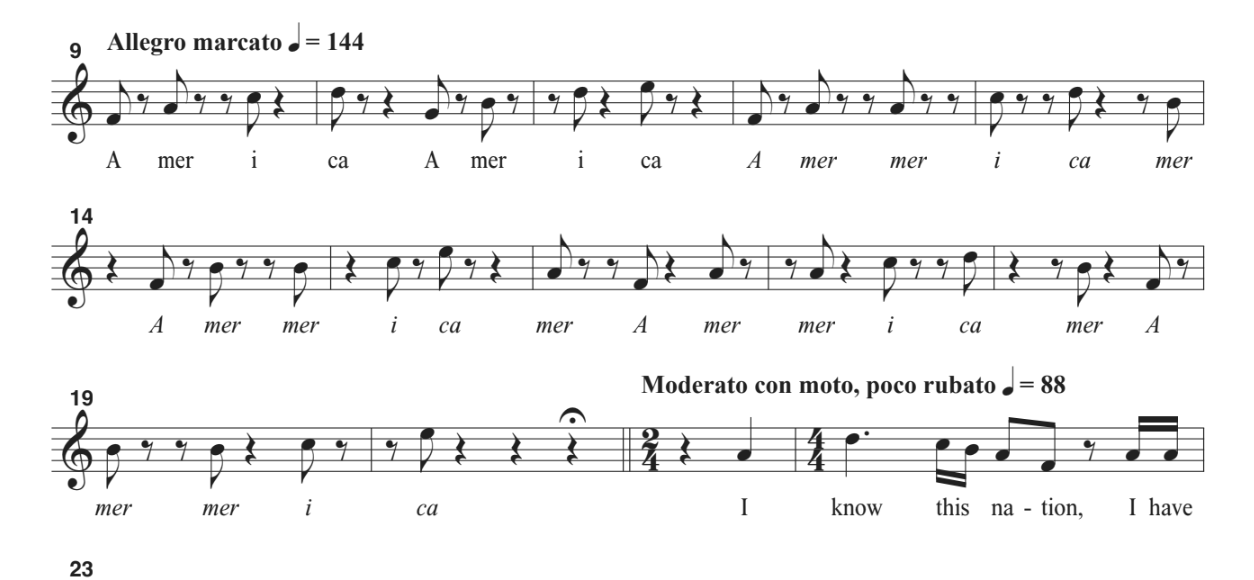
Here is an image of the score where you can see the sentence broken up into the modulo Fibonacci:
Regular Sentence:
America
America
The sentence has 8 syllables, we will call this “mod 8”. Here they are broken up:
A / mer / i / ca
A / mer / i / ca
This is how the sentence is applied to the modulo Fibonacci sequence:
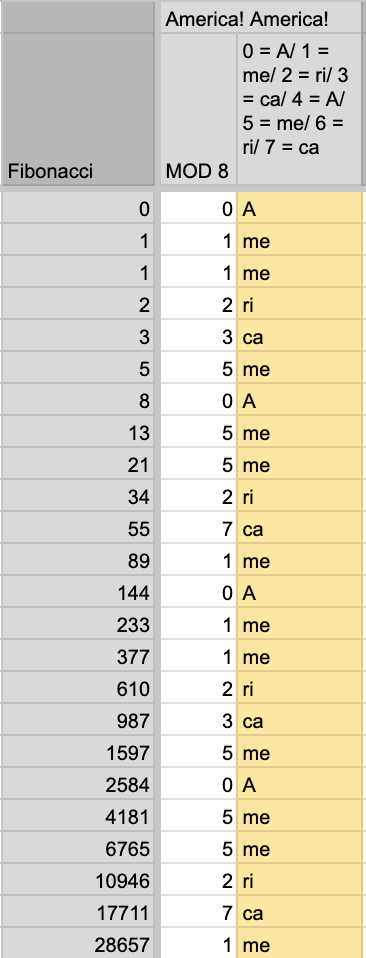
In the music, “America America” will now be sung like this repeatedly:
A mer i ca
A mer i ca
A mer mer i ca mer
A mer mer i ca mer
A mer mer i ca mer
A mer mer i ca
Neely Bruce composed this scene, and you can hear how this sentence has been applied to notes. As the syllables are sung in their modulo sequence over and over again, you can imagine that the original English sentence will start to resonate, making the dialogue more easily understandable.
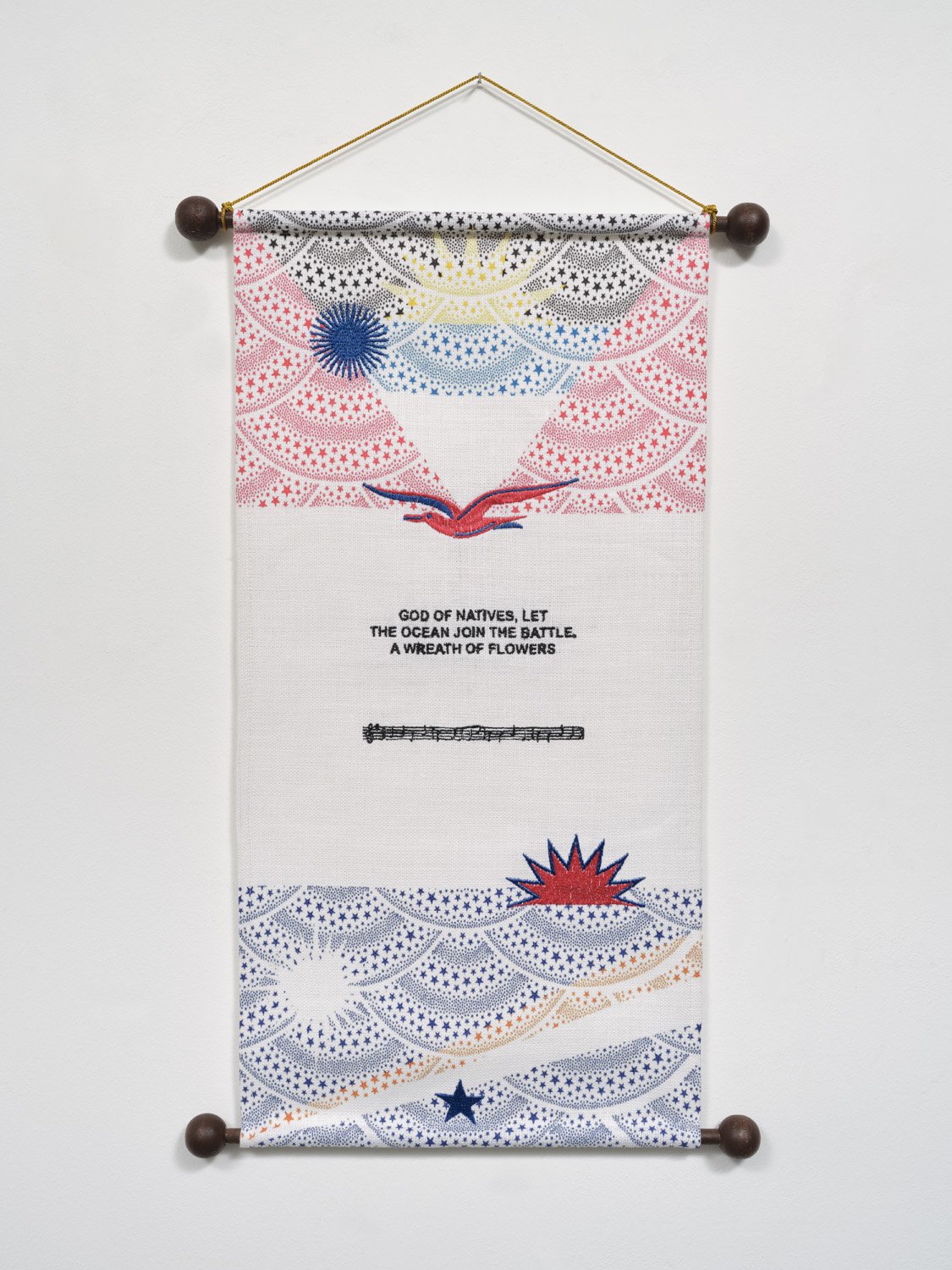
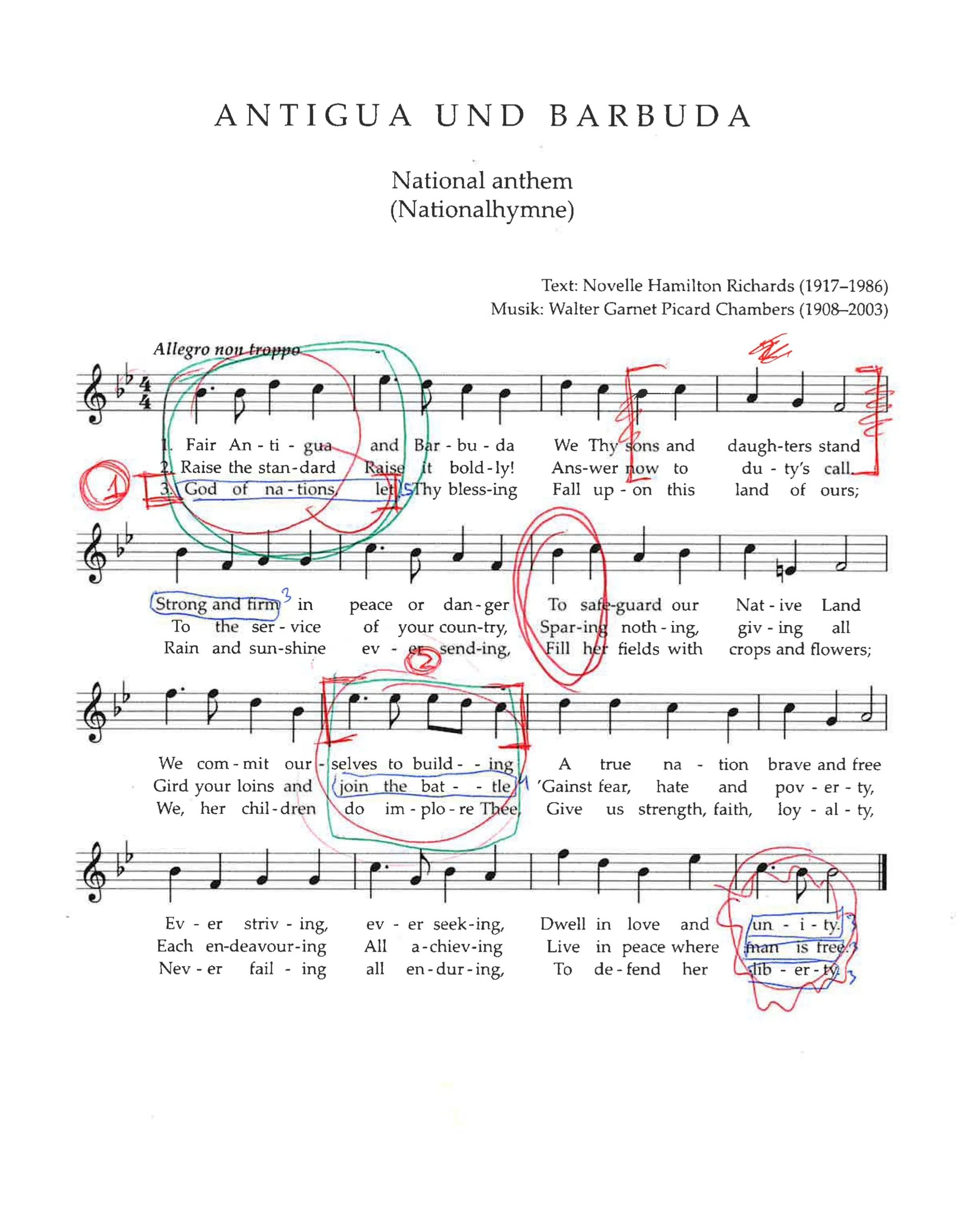
2025, Tammy Nguyen, Revolutions of the Same and the Other: Antigua Barbuda and The Marshall Islands. Photo by Daniel Kukla.
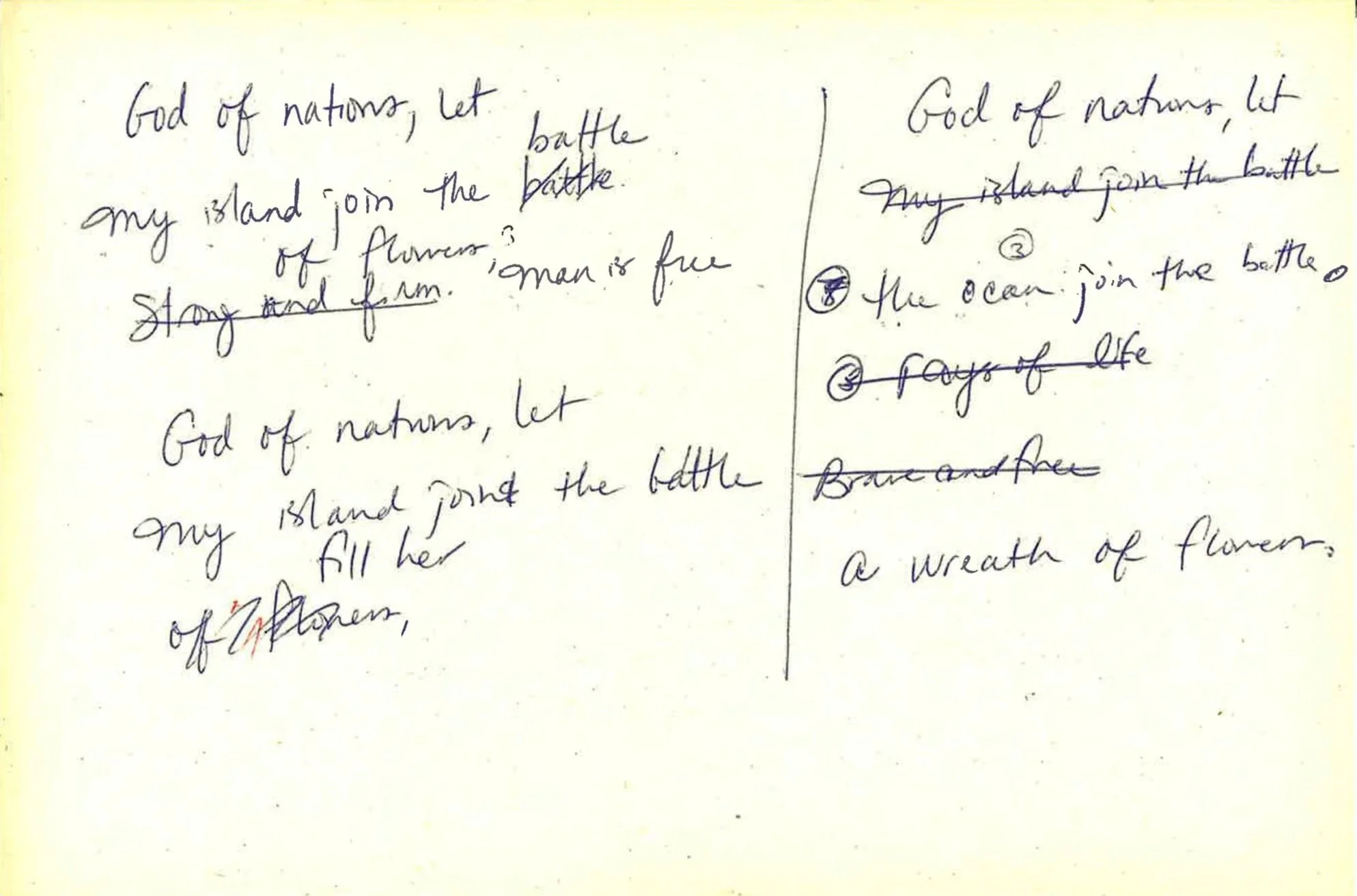
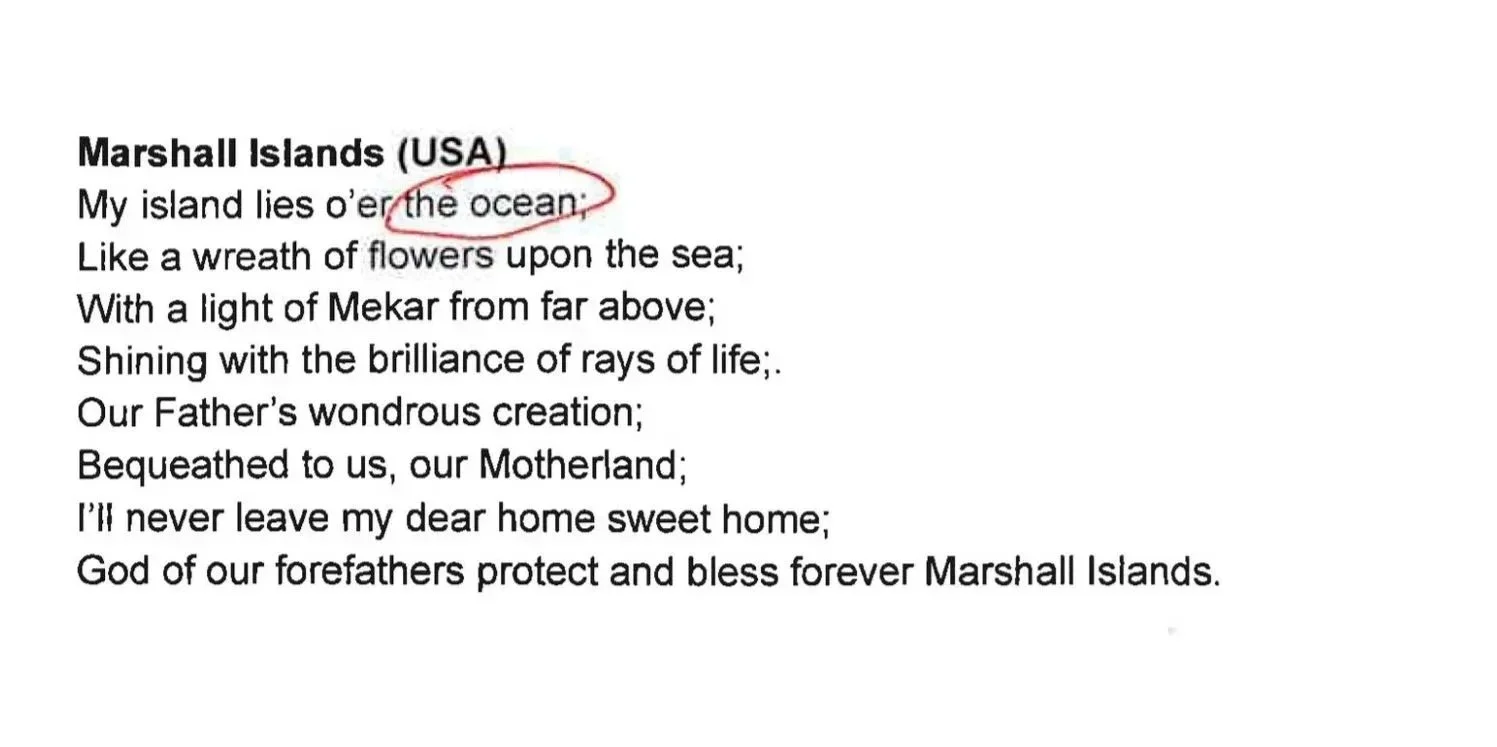
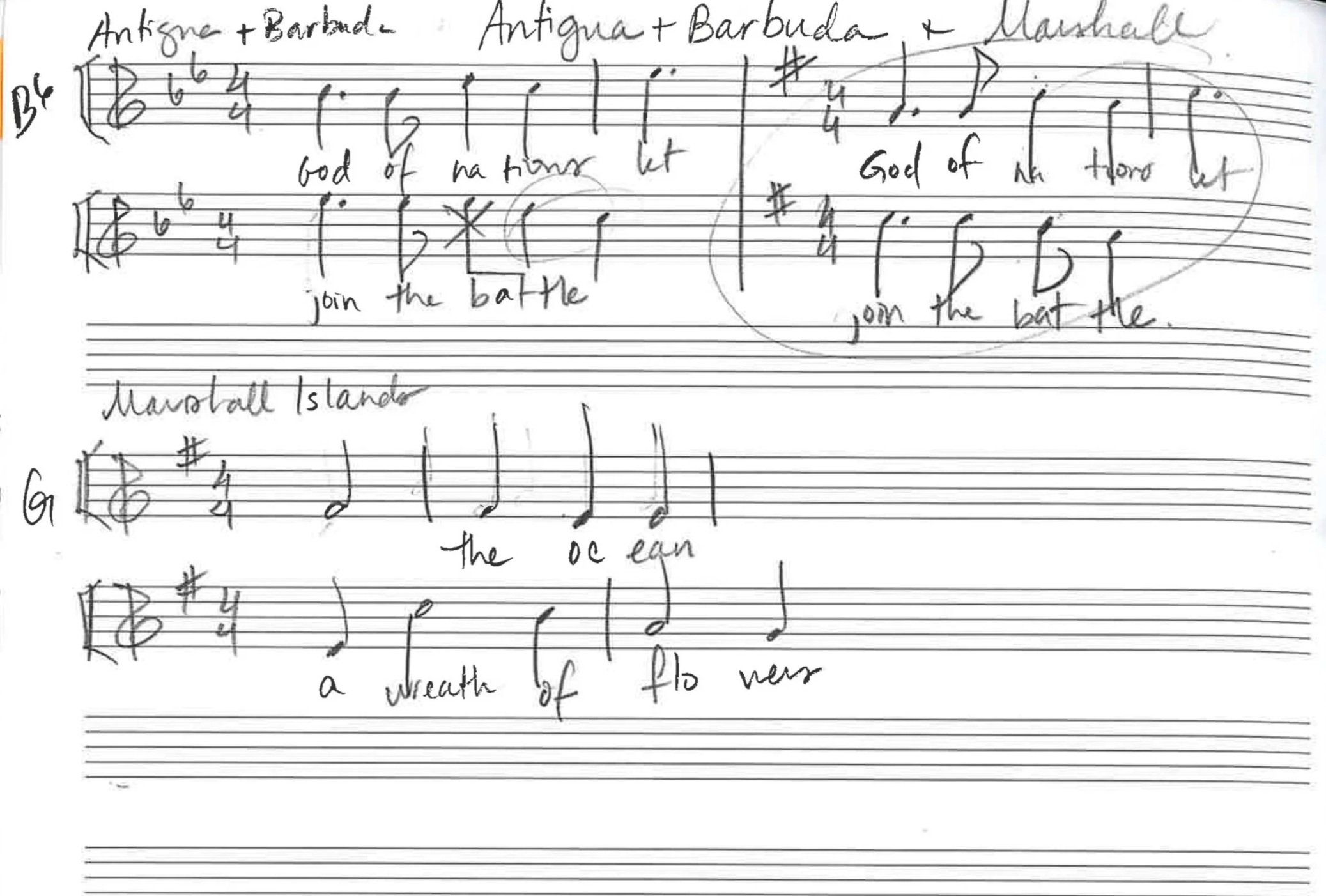
The opera’s libretto and music grew out of one of Nguyen’s earlier projects, Revolutions of the Same and the Other, a series of 23 embroidered tapestries that combine the colors and patterns of 46 nations’ flags to explore the moral ambiguities and contradictions of nationhood and global trade. These tapestries, embroidered with symbols and excerpts of national anthems, highlight the arbitrary construction of nationhood cultivated through the display of national symbols. You can listen to Nguyen’s reimagined and reconstructed pseudo-anthem for Antigua Barbuda and The Marshall Islands here.
Revolutions of the
Same and the Other